Pili Annulati With Severe Trichorrhexis Nodosa a Case Report and Review of the Literature
Standing Education Activity
Pili annulati is an inherited, rare, and beneficial hair shaft disorder characterized by a unique advent of the pilus with alternate light and night bands. Pili annulati belongs to the group of hair shaft disorders without fragility. This activity illustrates the various presentations and reviews the evaluation and management of pili annulati. This activeness highlights the function of the interprofessional team in collaborating to constitute the diagnosis and return the best intendance for affected patients.
Objectives:
- Draw the etiology and pathophysiology of pili annulati.
- Explain the common physical exam findings in pili annulati
- Depict the typical trichoscopic and microscopic findings associated with pili annulati.
- Explicate the importance of collaboration and advice amongst the interprofessional squad to establish the diagnosis of pili annulati and to enhance patient intendance.
Introduction
Pili annulati (PA), also known equally «ringed » or "Morse alphabet" pilus, is a rare benign disorder characterized by a unique speckled and banded appearance of the hair with alternating light and dark bands.[1][2][3] This appearance results from an increased light reflex acquired past a periodic occurring of aberrant air-filled cavities within the hair shafts of afflicted individuals.[iii] Pili annulati belongs to the grouping of hair shaft disorders without fragility. Although there are reports of some desultory cases, it is considered to be an inherited disorder.
Etiology
Inheritance of pili annulati is via an autosomal dominant blueprint with variable expression. A locus responsible for pili annulati was mapped on the terminate of the telomeric region of chromosome 12q (24.32–24.33), but the responsible gene for the disease is not notwithstanding completely identified.[iv] So far, a critical region of two.9 Mb containing 36 candidates genes has been divers past recombination events.[five]
A report exists of a case of pili annulati associated with Rothmund-Thomson syndrome caused past a mutation in RECQL4.[half-dozen]
The literature also describes sporadic cases.
Epidemiology
The prevalence of pili annulati is currently unknown. Information technology is presumed to be a rare hair shaft disorder. Since being beginning described in 1866, there are reports of approximately fifty cases in the literature.[seven]
No racial distribution is axiomatic for pili annulati.
Pathophysiology
Hair in pili annulati has a characteristic shiny and speckled advent with alternating calorie-free and dark bands. The light bands that are visible with the unaided eye under a refracted light, actually correspond to nighttime bands when seen under light (or polarized) microscopy. Past electron microscopy, these abnormal hair segments correspond to air-filled cavities within the hair shaft'south cortex.[7]
Altered light penetration of pilus explains this banded appearance in pili annulati. The abnormal spaces containing air cause double diffraction and handful of transmitted light, which results in a subtract of light transmission compared to normal areas, thus the dark appearance of abnormal areas under a light microscope. Conversely, under reflected light, the abnormal areas reflect more than lite and therefore appear lighter.[8]
These air-filled gaps in abnormal areas announced to result from an bereft matrix formation or a defective assembly of structural proteins in the matrix due to an abnormal regulatory poly peptide.[3][5][7]
Therefore, pili annulati appears to exist a protein metabolic disorder. A partial dysfunction of cytoplasmic ribosomes in the differentiating cortical cells is suggested to be involved.[1]
History and Physical
Pili annulati may announced at birth or during infancy.[9] The clinical expression tin be heterogeneous within the aforementioned patient at different regions of the scalp or even at different regions of the same afflicted hair.[vi][10][11]
The clinical examination usually reveals a shiny and banded advent of the hair with sometimes a peculiar glistening texture or even a frizzy attribute.[3] The number of white bands tends to disappear distally as the hair grows.
Pili annulati is not typically associated with increased hair fragility. Hair growth and tensile strength of hair in afflicted individuals are normal, only abnormal areas of the hair shafts appear to be more than susceptible to weathering and present with pocket-size surface abnormalities. In a minority of cases, an increased sensitivity at the level of the light bands with severe trichorrhexis-nodosa-like hair fracturing and breakage tin be observed.[7][12]
Pili annulati is classically limited to the scalp hair, just other regions such every bit pubic, axillary, and beard hair, may also be affected.[3][ten]
Pili annulati is easily detected in blonde pilus while it can be completely obscured in black hair, equally the additional pigment in dark pilus tends to absorb the surrounding calorie-free and mask the banding appearance. Pili annulati become more than noticeable with historic period as the hair becomes depigmented, increasing light transmission.[8]
There take been several reports of pili annulati associated with baldness areata, autoimmune thyroid disorders, as well as primary immunoglobulin A deficiency. The most unremarkably accustomed supposition is that these cases stand for a coincidental concomitant manifestation, as a true pathogenetic association has not been proven.[ii][3][6]
Evaluation
Light microscopy shows a feature appearance with alternate bright and dark bands in the hair shaft. The bands that announced dark in lite microscopy correspond to white bands macroscopically, nether reflected light, and in trichoscopy. Transmission electron microscopy of affected hairs shows a normal medulla with clusters of intermittent air-filled cavities within the cortex of the hair shafts. Scanning electron microscopy reveals a "cobblestoned" and fluted cuticle.[8][9]
Similar in other hair shaft disorders, trichoscopy represents a simple and rapid method that enables the practitioners to found the diagnosis of pili annulati without the demand to pluck hairs.
In both nighttime and blond hairs, It demonstrates regular light-colored bands roofing more 50% of the hair shaft width, giving a "misty-like" appearance. This trichoscopic image of pili annulati may exist misdiagnosed as "intermittent medulla," seen inside thick hair shafts in salubrious individuals. In these cases, intermittent light-colored bands embrace less than 50% of the hair shaft'southward thickness.[6][13]
Treatment / Direction
Treatment in pili annulati is often non required as it is a benign condition in which patients rarely seek medical attending. The shiny advent of the pilus is infrequently bothersome, and some [atients even consider it attractive.
There have been a few reports of a disappearance of the "ringed" appearance of the hair after daily utilize of topical minoxidil.[ii]
In rare forms associated with hair breakage and fragility, gentle hair care is the recommendation.
Differential Diagnosis
The master differential diagnosis that merit consideration is pseudopili annulati. It presents with a banded clinical appearance similar to pili annulati with light and nighttime bands. However, this clinical attribute is an optical effect that results from a slight twisting of the pilus shaft. Trichoscopy hands establishes the diagnosis as information technology shows twisted hairs without white bands.[three][6][viii]
Prognosis
The prognosis of pili annulati is excellent as it is a benign condition that doesn't affect the quality of life of affected patients.[2]
It is, even so, essential to clarify that pili annulati becomes more than obvious and manifests farther with historic period equally the pigment loss causes an increment in light transmission.[8]
Enhancing Healthcare Team Outcomes
Pili annulati is a hair shaft disorder that does non cause cosmetic bug. Therefore, affected individuals rarely seek medical attention.
Like other congenital hair shaft disorders, pili annulati may exist seen at birth or during early infancy. Hence, pediatricians and pediatric nurse practitioners are likely to meet such cases. Careful clinical examination is necessary to establish the diagnosis of pili annulati as it is an asymptomatic condition. An interprofessional and an interprofessional healthcare team approach is essential to render to best patient intendance, including physicians and specialty-trained nursing staff.
(Click Image to Enlarge)
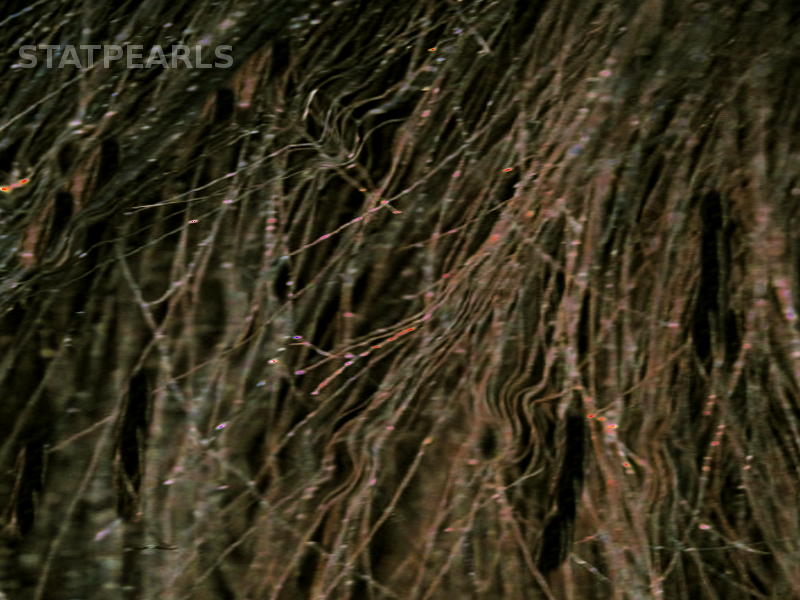
Pili annulatii
Paradigm courtesy S Bhimji MD
References
[1]
Ito Thousand,Hashimoto M,Sakamoto F,Sato Y,Voorhees JJ, Pathogenesis of pili annulati. Archives of dermatological enquiry. 1988; [PubMed PMID: 2460036]
[two]
Singh G,Miteva M, Prognosis and Management of Built Pilus Shaft Disorders without Fragility-Part II. Pediatric dermatology. 2016 Sep; [PubMed PMID: 27293153]
[three]
Theodosiou G,Hamnerius N,Svensson Å, Banded Scalp Pilus with an Unusual Glistening Appearance in a Teenager: A Quiz. Acta dermato-venereologica. 2018 April 16; [PubMed PMID: 29362812]
[iv]
Green J,Fitzpatrick East,de Berker D,Forrest SM,Sinclair RD, A factor for pili annulati maps to the telomeric region of chromosome 12q. The Periodical of investigative dermatology. 2004 Dec; [PubMed PMID: 15610516]
[5]
Giehl KA,Rogers MA,Radivojkov M,Tosti A,de Berker DA,Weinlich 1000,Schmuth M,Ruzicka T,Eckstein GN, Pili annulati: refinement of the locus on chromosome 12q24.33 to a ii.9-Mb interval and candidate cistron analysis. The British journal of dermatology. 2009 Mar; [PubMed PMID: 19067701]
[six]
Rudnicka L,Olszewska M,Waśkiel A,Rakowska A, Trichoscopy in Hair Shaft Disorders. Dermatologic clinics. 2018 Oct; [PubMed PMID: 30201151]
[vii]
Osório F,Tosti A, Pili annulati--what about racial distribution? Dermatology online periodical. 2012 Aug xv; [PubMed PMID: 22948060]
[8]
Moffitt DL,Lear JT,de Berker DA,Peachey RD, Pili annulati coincident with alopecia areata. Pediatric dermatology. 1998 Jul-Aug; [PubMed PMID: 9720689]
[nine]
Amichai B,Grunwald MH,Halevy South, Pilus abnormality present since babyhood. Pili annulati. Archives of dermatology. 1996 May; [PubMed PMID: 8624159]
[10]
Teysseire S,Weiler L,Thomas 50,Dalle S, [Pili Annulati]. Annales de dermatologie et de venereologie. 2017 May; [PubMed PMID: 28109542]
[eleven]
Laniosz V,Podjasek JO,Camilleri MJ,Manus JL, Pili annulati masquerading as hypotrichosis. Pediatric dermatology. 2013 Jul-Aug; [PubMed PMID: 23819454]
[12]
Nam CH,Park Chiliad,Choi MS,Hong SP,Kim MH,Park BC, Pili Annulati with Multiple Fragile Hairs. Annals of dermatology. 2017 Apr; [PubMed PMID: 28392665]
[thirteen]
Rakowska A,Slowinska Grand,Kowalska-Oledzka Eastward,Rudnicka 50, Trichoscopy in genetic pilus shaft abnormalities. Journal of dermatological case reports. 2008 Jul vii; [PubMed PMID: 21886705]
Source: https://www.statpearls.com/ArticleLibrary/viewarticle/504
Post a Comment for "Pili Annulati With Severe Trichorrhexis Nodosa a Case Report and Review of the Literature"