Do You Need a Post Doc to Teach at a Liberal Arts School
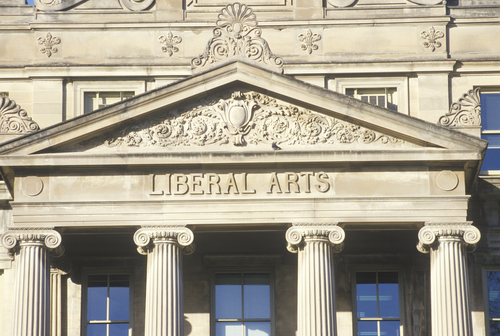
When you're comparing colleges as a prospective student, consider what kind of schoolhouse is right for you and what kind of teaching you lot want. Liberal arts colleges provide students with a broad education that combines numerous subjects of report in the arts, natural and social sciences, and humanities for the purpose of learning how to call up and communicate. Rather than preparing students for a unmarried career path, a liberal arts teaching equips students with the skills and noesis they need to be meliorate learners, thinkers, and global citizens.
A Liberal Arts Curriculum
At a liberal arts higher, you will study a diverseness of subjects in the arts, humanities, and natural and social sciences. Students in liberal arts colleges may study several of the artistic arts. Courses in fine art, music, theatre, and artistic writing are common. The humanities refer to subjects that study the human condition and civilization. In liberal arts programs, students oft accept humanities courses such as history, classical or modern foreign languages, philosophy, English literature, and theology. Social sciences, too, hold an important place in a liberal arts curriculum. Wait to written report subjects like sociology, geography, anthropology, political science, and economics during your liberal arts instruction.
You might not be able to tell past the proper noun, merely mathematics and science are crucial subjects of study in a well-rounded liberal arts education. Courses similar biology, physics, and chemistry are common in a liberal arts curriculum. Students typically have to have a minimum of 1 higher-level math grade during their academic careers, with options ranging from statistics to algebra, trigonometry, and calculus.
The Jobs of Tomorrow
Most people have a moment when they're young where they think, When I grow up, I'm going to be a ____ and they make full in the blank with whatever career appeals to them at that moment. While it'southward prissy to dream about the jobs we might hold tomorrow, the truth is about people don't actually know what the jobs of tomorrow will be. According to Southwestern Academy, this statement isn't hyperbole. Around 65% of students today volition be in jobs in the future that don't exist today. Even more unsettling is the fact that twoscore% of the jobs that currently exist won't exist in the future. They'll become obsolete.
It begs the question, and then, how are students expected to prepare for this eventuality? Won't this reality make college degrees useless? No, that isn't the case. The people who are best suited for these jobs are those who studied the liberal arts.
Here's why. A liberal arts didactics teaches students how to think and to solve issues. Call back about it this manner. 1 plus ane always equals two. Unfortunately, problems fill the world that don't fit into swell mathematical equations. More than one correct reply to a problem often exists. Some problems likewise require more than than one solution in order for them to be solved effectively. Those who know how to use their creative muscles unremarkably solve those problems.
…It's technology married with liberal arts, married with humanities, that yields us the results that make our center sing. – Steve Jobs
Information technology isn't that Stem career fields don't have their place in the world. They definitely do. However, as even many in the Stem fields have begun to discover, the problems that cause bug in the Stalk globe are human problems. Technology past itself won't solve those problems. Someone with an understanding of both STEM and the humanities has a better shot at it.
It stands to reason, then, that the jobs of the futurity will be held by people who know how to solve problems, peradventure even problems that the modern workplace hasn't experienced withal. The liberal arts students of today accept put themselves in the position of existence the workplace problem-solvers of tomorrow. They become the people working in the jobs of tomorrow.
Education Across the Disciplines
A liberal arts pedagogy equals an didactics that spans the disciplines. Many universities require their students to complete a certain number of classes in subjects that aren't related to a student's major. Schools often phone call these clusters of classes core or foundational classes. These include classes in literature, arts, sciences, mathematics and social sciences. These courses provide students with a foundational knowledge of the world and its history.
These classes introduce students to subjects they may not run into otherwise. Sometimes, these courses fifty-fifty influence a educatee'due south decision when it comes fourth dimension to pick a major. A class that introduces students to the written report of art, biology, or field archæology may become the stepping rock to a whole career down the road. Given that many students enter college with no detail major in mind, it really is possible for a seemingly random class to change a student's whole career outlook. Often that's how people encounter their dream careers: by accident.
Aside from this, these classes help students sympathize how i subject area affects another. For case, in a foundational geology course, students may learn that in 1815, a volcano erupted in Indonesia. Co-ordinate to Forbes, the effects of the 1815 volcano were such that it changed the weather effectually the globe, including in Europe in 1816. That yr also happened to exist the twelvemonth that Mary Shelley wrote "Frankenstein." Shelley's book was partly influenced by the dark and stormy weather condition that the volcanic eruption caused. In fact, people chosen 1816 "the year without summer" considering the volcanic ash caused terrible conditions.
Growing crops was incommunicable in 1816. People starved. They moved across the European mural in search of nutrient, much the style the animal in "Frankenstein" did. His appearance is said to exist inspired past those climate refugees. Out of this devastation came one of the most beloved pieces of literature the globe has ever known.
A liberal arts education exposes students to facts like this. Information technology allows them to see how seemingly unrelated events affect the earth. This exposure gives rise to newer, broader means of thinking. As "Frankenstein" proves, a situation that occurs halfway around the globe from someone can accept profound effects on localities half a world abroad. The study of liberal arts teaches students virtually these events. Information technology also forces them to examine how they might deal with such an event, which broadens their creative thinking and trouble-solving skills.

A Component of STEAM
Many people who work in engineering have begun to understand that not anybody wants a career in a Stem field (science, technology, engineering, or math). However, that doesn't mean that liberal arts majors and STEM majors demand to be at cross-purposes with each other. On the reverse, each subject field has something to offer its analogue.
The improver of the "A" and the "R" to STEM brings both the arts and reading and writing into the Stalk curriculum. Truth be told, many students in the liberal arts use engineering every solar day to practise their work. On the flip side, those who embrace Stem fields encounter the shortfall that simply concentrating on Stem causes.
Very oft, STEM bug aren't due to technical problems per se. Instead, they arise because humans run engineering. They encounter ethical issues. They realize that the digital separate keeps some people from accessing applied science in a mode that is meaningful. STEM training alone doesn't solve these issues. Cognition of the human condition and ethics oft does. For example, a student who studied philosophy may go on to take a career in wellness administration or law, according to the University of Maryland because these career fields require people to have an understanding of ideals and the humanities.
That being said, a person who has studied philosophy, one of the many liberal arts majors available to students, is in a unique position to move into a tech career. This is due in part to the fact that this particular liberal arts degree requires students to study logic. It as well taps into how the brain works and how people think. That being said, modern computer scientists ofttimes try to replicate how the man brain thinks, something that liberal arts majors must call up near a lot. This puts many liberal arts majors (and not just philosophy majors) in the running for some very cool, very lucrative careers.
Career Options for Liberal Arts Majors
Many people mistakenly believe that a liberal arts education is the easy mode to a caste. Zero could be further from the truth. A liberal arts education requires students to adhere to rigorous standards of enquiry, to develop problem-solving skills, and to expend a large dose of commitment in order to achieve their educational goals.
A liberal pedagogy too prepares students for a number of careers that may not seem to be related on the surface. However, due to the wide nature of these types of degrees and due to the transferable skills they teach students, a liberal arts degree can actually translate into very lucrative job options.
 Some liberal arts students parlay their power to write, a skill they honed during their college days, to become writers. Many turn to careers in journalism or public relations. Others combine their love of technical subjects and writing to become technical writers. Depending on the task they do and the number of years of feel they bring to the table, these former liberal arts majors earn betwixt $61,000 and $70,000 a year.
Others plough their love of promotion into a lucrative career in the field of marketing. Possible jobs include marketing manager, SEO writer, advertisement designer, or art director. These professionals earn between $100,000 and $131,000 per yr, according to Maryville University.
The field of education besides proves to be a popular option among liberal arts graduates. Typically, these graduates choose a major, like fine art or biology, and and so they tack on classes in education. If these students earn a bachelor's degree, they become simple or high school teachers. If they earn avant-garde degrees, like a chief's or doctorate, they qualify for didactics positions at the university level.
Given how much liberal arts students must read and write during the course of their studies, it's no wonder that many of them become excellent researchers in the process. This skill qualifies them to become research analysts. Big companies hire researchers when they need to make decisions about rolling out new products services or if they want to move into new markets. Inquiry analysts make nearly $80,000 a year on average.
 Translators and interpreters unremarkably come to the ranks of former liberal arts majors. People who major in world languages put themselves in a position to translate documents, books, TV shows, and movies or to interpret proceedings at conferences, business meetings, and in court. U.South. News & World Written report name translation and interpretation equally the #1 jobs on the news site's Best Creative and Media Jobs list.
People who speak Spanish, Chinese, German, Portuguese, and Russian have peculiarly lucrative futures ahead of them. Demand for those who have these skills is expected to increment past virtually twenty% through the year 2028. On average, translators and interpreters brand most $fifty,000 per twelvemonth, though the all-time paid among them make $67,000 a year and above.
An Didactics for the Sake of Learning
At a liberal arts college, the master goal is teaching itself, more so than job training, according to The Hechinger Report. Instead of focusing mainly on learning specific technical skills that can become outdated very quickly thanks to changes in technology and the economy, a liberal arts didactics teaches students to think, learn, and communicate. That doesn't mean a liberal arts education is useless for getting a job. A liberal arts curriculum includes plenty of reading, critical thinking, and work involving written and speech communication. This makes for not bad preparation for graduate school in subjects such equally business organisation, engineering, law, and even medicine.
The pedagogy path also allows students a chance to cultivate versatile skills that employers in all fields prize, similar teamwork, communication, and belittling skills, CBS News reported. Liberal arts students become good at thinking critically, seeing the large picture, working with a team, and communicating well. Between these skills and their solid educational groundwork in many subjects, liberal arts students have a potent foundation that allows them to fit into a wide variety of careers.
A liberal arts instruction is a swell option for students who love to learn and desire to develop abilities that make them improve students, more insightful employees, and more aware citizens.
Related Resources:
20 Affordable Main's in Journalism Online Programs
Top thirty Most Affordable Master'southward in Reading Online Programs
Top 10 Highest Paying Jobs For Liberal Arts Majors
Source: https://www.bestcollegesonline.org/faq/what-does-a-liberal-arts-education-teach-you/

Post a Comment for "Do You Need a Post Doc to Teach at a Liberal Arts School"